Free shipping on orders over $999. Only Email is live.

The Sacred Art of Chinese Thangka — A Window into Tibetan Buddhist

TraditionIntroductionThangka, also known as Tangka or Tangka painting, is a profound form of Buddhist scroll painting that originated in the Tibetan plateau and has been an integral part of Chinese cultural heritage for centuries. These intricate artworks serve not merely as decorative pieces but as sacred objects of devotion, meditation, and spiritual education within the Tibetan Buddhist tradition. As a unique synthesis of artistic craftsmanship and religious practice, Thangka embodies a rich philosophical worldview that continues to inspire practitioners and art enthusiasts around the globe.Historical Origins and Cultural SignificanceThe origins of Thangka painting can be traced back to the 7th century during the reign of King Songtsen Gampo, who unified the Tibetan Empire. It is believed that the technique of Thangka creation was influenced by Buddhist murals from India, Nepal, and the Central Asian Silk Road trading routes. Over time, Tibetan artists developed their own distinctive style, blending elements from these diverse traditions with indigenous Tibetan aesthetics and spiritual concepts.Within Chinese culture, Thangka holds a special position as a precious art form nurtured within the broader context of Tibetan Buddhism. The Qing Dynasty court, under emperors such as Qianlong, actively supported and collected Thangka, recognizing its immense cultural and spiritual value. This patronage contributed to the preservation and proliferation of Thangka artistry across different regions of China, particularly in areas such as Qinghai, Gansu, and Sichuan where Tibetan Buddhist monasteries flourished.Symbolic Elements and IconographyA defining characteristic of Thangka is its elaborate iconographic system. Every element within a Thangka carries profound symbolic meaning. The central figure, typically a Buddha, Bodhisattva, or deity, is surrounded by celestial beings, lotus flowers, vajra scepters, and sacred geometry. The use of specific colors is not arbitrary — gold represents enlightenment and compassion, red signifies active compassion, blue embodies the path of transformation, and green represents the activities of all Buddhas.The composition of a Thangka follows precise cosmological schematics based on Buddhist texts and tantric visualizations. Deities are arranged according to specific hierarchical relationships, and even the positioning of hands (mudras) and ornaments carry distinct meanings. A well-executed Thangka serves as a visual meditation tool, allowing practitioners to focus their minds on the qualities of enlightened beings.The Meticulous Creation ProcessCreating a Thangka is a labor-intensive endeavor that demands exceptional artistic skill and spiritual dedication. The process begins with the preparation of the canvas, which is treated with a mixture of chalk and animal glue to create a smooth painting surface. Artists then sketch the design using precise grid systems based on ancient proportional guidelines passed down through master-to-apprentice lineages.The painting itself employs mineral and organic pigments derived from natural sources — malachite for green, cinnabar for red, gold leaf for gilded accents, and soot for black. These pigments are mixed with binding agents and applied in multiple layers to achieve the characteristic luminosity and depth of Thangka colors. Finally, the painting is mounted on silk borders and consecrated by qualified lamas, transforming it from an artwork into a sacred object.Preservation and Contemporary Relevance
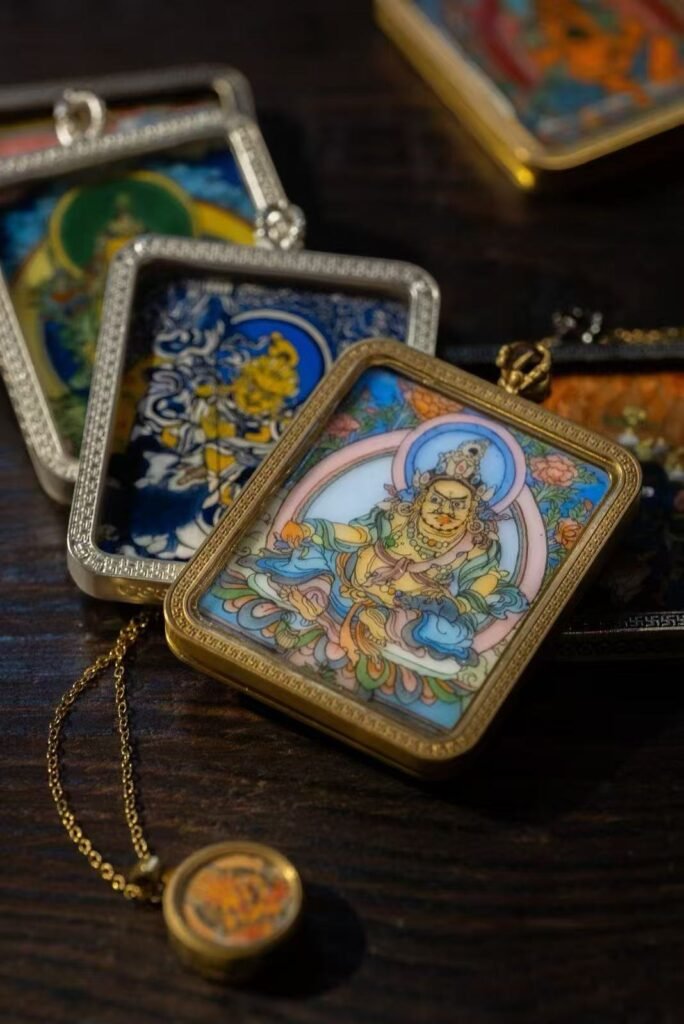
Today, Thangka faces the dual challenges of preservation and adaptation. Efforts by Chinese cultural heritage authorities and international organizations have focused on documenting existing Thangka, training new generations of artists, and establishing museums and conservation centers. Meanwhile, contemporary Thangka artists navigate the tension between maintaining traditional standards and responding to modern artistic sensibilities.ConclusionChinese Thangka represents far more than a visual art form — it is a living tradition that continues to transmit Buddhist teachings, cultivate spiritual qualities, and preserve intangible cultural heritage. As both a religious artifact and an artistic masterpiece, Thangka invites us to contemplate the nature of devotion, beauty, and enlightenment across cultural boundaries.