Free shipping on orders over $399


why called ceramic thangka?

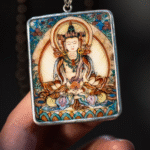
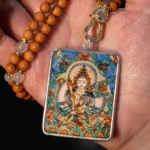
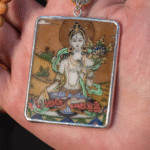
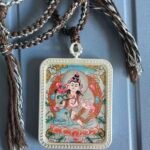
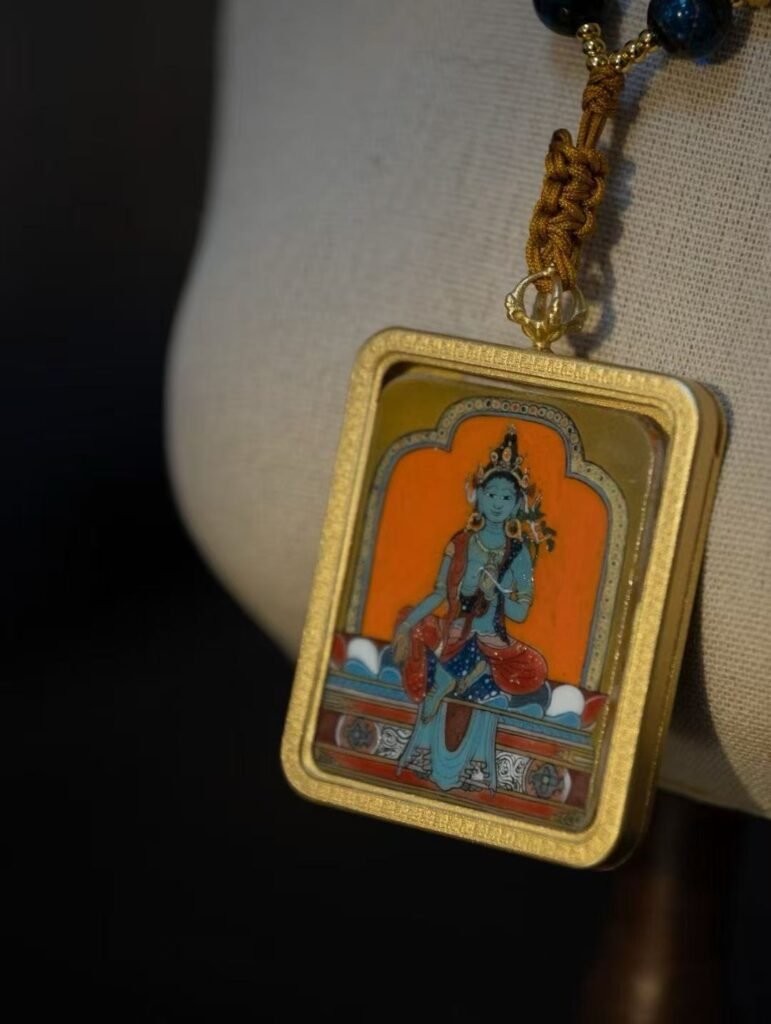
For hundreds of years, thangkas have been painted primarily on three types of media: paper, fabric, and leather. Ceramic thangkas, however, are a newly emerging artistic form that has developed in recent years along with the growing influence of thangka art. Although still in its early stages, ceramic thangka art has already demonstrated powerful artistic vitality and has been widely admired by those who encounter it.
Ceramic thangkas have great potential for future development, and ceramics are likely to become an important “fourth medium” for thangkas in the coming millennium. Both thangkas and ceramics are traditional national treasures unique to the Chinese cultural sphere, and the connection between ceramics and Buddhism also has a long and rich history. In the long run, the innovation of ceramic thangkas as a “fourth medium” will hold milestone significance in the historical development of thangka art.
Production Techniques
The ceramic panels selected for ceramic thangkas are made from high-quality porcelain clay and fired at temperatures above 1300°C. The panels must be firm, flat, and adjusted to provide different surface glosses or glazes depending on the needs of the artwork. The production of a ceramic thangka generally involves several steps: drafting, outlining, coloring, gilding, firing, and mounting. These steps often overlap and may need to be repeated multiple times. For example, the outlining may require two to four passes, and firing usually involves three to five rounds.
Drafting the Design
The first step in creating a ceramic thangka is sketching the design onto the chosen porcelain panel. This can be done by drawing directly with a pencil or by transferring a paper thangka draft onto the panel, depending on the individual painter’s preferred technique. This step demands exceptional precision and meticulous attention to detail.
Once the draft is completed, the artist outlines all lines of the thangka—typically with black pigment. The quality of the linework is a crucial factor in determining the overall standard of the thangka. Lines that are uneven, broken, hesitant, or clumsily traced are signs of untrained or careless work. After the entire outline is completed, the panel undergoes its first firing. It is then allowed to cool naturally before coloring begins.
Coloring
Coloring a ceramic thangka is far more demanding than simply applying pigment evenly. The artist must fully understand and master ceramic pigments—materials completely different from ordinary paint because they must withstand high temperatures. Achieving a color after firing that matches the original design often requires testing with small sample tiles. This is one reason many workshops are reluctant to accept single-piece custom orders or may charge extra.
Additionally, different artists have their own methods of adjusting pigments—such as adding certain substances to enhance brightness and saturation, or modifying pigments with different firing temperatures so they can be fired together. After the colors are applied, the panel is fired again. It should be noted that because pigments require different firing temperatures, multiple firings are often necessary.
Firing
Once all colors have been applied and fired, the artist usually refines the linework and begins applying gold outlines or gold-fill details. Most thangkas contain gold elements, and in some cases they make up a large portion of the composition. High-quality thangkas use real gold, and specialized techniques are employed to make the gold appear radiant. Whether genuine gold and high-quality mineral pigments are used is a major factor in determining both the quality and price of a ceramic thangka.
After all gold work is completed, the ceramic thangka undergoes a final firing. When it has cooled naturally, the artwork is finished. It is worth mentioning that the firing process involves significant risk—an artwork that required months to complete may crack during the final firing, causing devastating loss. If additional techniques are applied, such as adding “glass white” areas or using high-temperature colored glazes, the risks are even higher. For this reason, when producing a custom piece, manufacturers often create two panels simultaneously.
Mounting
The final step is mounting the finished ceramic thangka. This is not a simple task—selecting a frame that complements the artwork with taste and discernment is crucial. Some ceramic thangkas are placed in frames with glass panels, but this is unnecessary, even detrimental, since ceramics are durable and can be safely touched and cleaned directly.
Significance and Impact
Ceramic thangkas are not merely fabric thangkas transplanted onto porcelain. Ceramic craftsmanship and its unique artistic language endow the thangka with new expressive power. This is why people seeing ceramic thangkas for the first time are often immediately captivated by their distinctive charm. In recent years, ceramic thangkas have repeatedly won awards at major exhibitions, reflecting the strong appreciation and recognition this new art form has received.
Most importantly, ceramic thangkas have one exceptional advantage known to all—they can “virtually last forever.” This durability makes them especially cherished by Buddhist communities and art collectors.