Free shipping on orders over $399

The Symbolism and Spiritual Significance of Thangka

Every element within a thangka carries profound symbolic meaning, transforming the painting into a visual language of Buddhist philosophy and spiritual practice. Understanding this symbolic vocabulary reveals the extraordinary depth encoded within these seemingly static images.
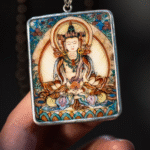
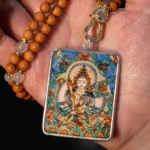
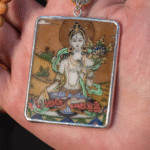
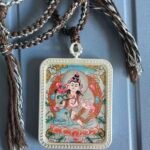
The central deity in a thangka represents an aspect of enlightened consciousness, a fully realized Buddha or bodhisattva whose qualities practitioners aspire to develop within themselves. Deities appear in various forms: peaceful forms embodying compassion and wisdom, and wrathful forms representing the fierce protection of Buddhist teachings against spiritual obstacles. Each posture, gesture, and attribute communicates specific spiritual qualities through established iconographic conventions.
Hand gestures, called mudras, are among the most significant symbolic elements. The Dharma chakra mudra, representing the turning of the wheel of teaching, depicts the Buddha with thumb and index finger forming a circle while the other fingers extend upward. The Bhumisparsha mudra, calling the earth to witness, shows the Buddha touching the earth with one hand, commemorating his enlightenment under the Bodhi tree. The Dhyana mudra, meditation gesture, portrays the Buddha with both hands resting in the lap, symbolizing concentration and inner peace.
Lotus flowers, appearing beneath the feet or throne of deities, symbolize spiritual awakening emerging from the murky waters of worldly existence. The lotus seed begins its growth rooted in mud but rises above the water to bloom in perfect purity, mirroring the practitioner’s journey from confusion to enlightenment. Different lotus colors carry specific meanings: white lotuses represent mental purity, pink lotuses are associated with the historical Buddha, and blue lotuses symbolize wisdom conquering ignorance.
The vajra, a ritual thunderbolt scepter, represents the indivisible union of wisdom and compassionate method, the diamond-like unshakable reality of emptiness. Bells held in the other hand symbolize the wisdom that recognizes emptiness. Mandalas, circular sacred diagrams, depict the celestial palace of a deity, representing both the macrocosm of the universe and the inner landscape of the enlightened mind.
Color symbolism in thangka is equally precise: the deep blue of lapis lazuli represents the medicine Buddha and healing qualities; gold signifies the essential nature of enlightened mind; red embodies the activity of compassion and the power of wisdom; green represents the activity of the Dhyani Buddha Amoghasiddhi and the pacification of aggression.
Thangka paintings function as meditation aids, with practitioners using the image as a focal point for visualization practices. By contemplating the deity’s form, attributes, and symbolic environment, practitioners gradually transform their own consciousness to embody those qualities. In this way, thangka serves not merely as decoration but as an active tool for spiritual transformation, bridging the visible world of appearance with the invisible realm of ultimate truth.