Free shipping on orders over $999. Only Email is live.

Seeing a Thangka—Iconography, Rules, and the Viewer’s Role

A thangka is easy to admire and hard to “read” without context. As Smarthistory notes, a thangka is a Tibetan hanging scroll, usually painted on cotton, and placed into a silk brocade mount—and, importantly, it is governed by many rules compared with other kinds of painting.Those rules shape both how the image is made and how it is meant to be seen.
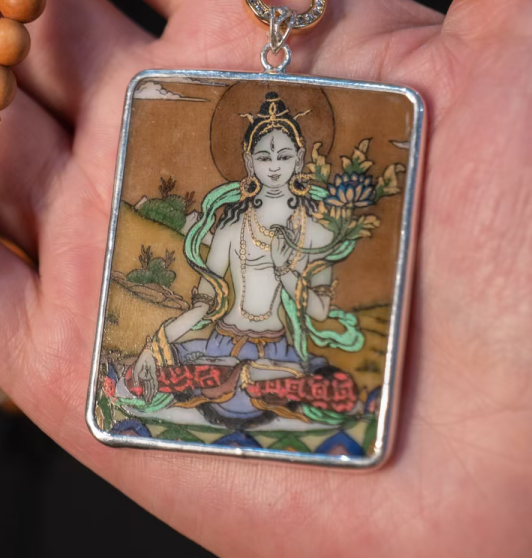
For a practitioner or informed viewer, a thangka is a structured field of meaning. The central figure—perhaps a Buddha, bodhisattva, protective deity, or revered teacher—sits within a hierarchy of symbols: hand gestures (mudras), ritual objects, animals, thrones, flames, lotuses, or surrounding figures. Even the spatial organization often carries doctrinal logic: what is central versus peripheral, peaceful versus wrathful, earthly versus celestial. That is why thangka instruction has historically depended on knowledgeable teachers who can explain what each element signifies and how the image supports practice.
The existence of “rules” does not imply rigidity in the negative sense; it implies a shared visual vocabulary. If a thangka is used in teaching, the teacher must be able to point and name: this identifies the figure, this explains the attribute, this indicates the narrative moment, this maps the mandala’s structure. Consistency lets the thangka function like a diagram of the sacred—beautiful, yes, but also legible and dependable.
This is also why thangka painting is widely described as rigorous and multi-step: the artist is not merely inventing; the artist is realizing a form that has to align with established iconography and proportional systems. Project Himalayan Art emphasizes that thangka painting requires “multiple precise s The viewer benefits from that precision: the image becomes a stable support for recognition and contemplation.
Museums today often present thangkas with labels emphasizing culture, date, and medium (for example, the Met identifies a Tibetan thangka as “distemper on cloth”). That information is valuable, but it is only one layer. Another layer is function: the scroll could be hung for a festival, used as a teaching aid, or displayed in a private shrine setting. A third layer is the viewer’s participation: a thangka can be “activated” through looking practices—careful attention, memorization, reflection, and, in some traditions, visualization.
Approached this way, a thangka becomes more than an image in the modern sense. It is a meeting point between craft, doctrine, and trained seeing. The rules are not barriers; they are the rails that allow the painting to carry meaning across generations—rolled up, carried, unfurled, and understood again.